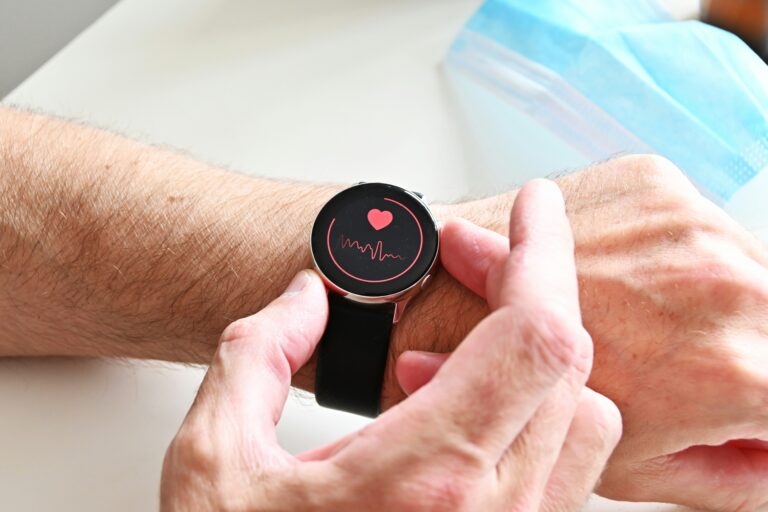
Fall Detection Wearables and Smart Home Sensors
By Simon Peter Lokomo, MPH — Public Health
The short answer
Lab testing of fall-detection wearables reports genuinely good numbers — several systematic reviews put average sensitivity above 93% and specificity above 86%. The problem is that almost none of that testing happens in the people these devices are actually sold to. It happens on young, healthy volunteers staging falls onto crash mats. The handful of studies that have tested real devices on real older adults in real homes tell a rougher story, including one pilot where a device with a manufacturer-claimed 94% lab sensitivity generated 83 false alarms and caught exactly one real fall over several months of actual use. These devices solve a real problem — most people who fall and can’t get up never press a help button even when they’re wearing one. They don’t yet have the evidence to back up the accuracy claims on the box.
If you’re looking at a smartwatch, a pendant, or a sensor kit for a parent right now, you are probably weighing peace of mind against a real cost, and wondering whether the accuracy numbers in the marketing are trustworthy. That’s a reasonable thing to wonder. The short version is: trustworthy for a controlled test, largely untested for the situation you actually care about.
The problem these devices are trying to solve
Falling and being unable to get up is common, and getting help afterward is less automatic than most families assume. In a year-long Cambridge study following people over 90, 80% of those who fell were unable to get up afterward on at least one occasion, and 30% lay on the floor for an hour or more. Call alarms were widely available to these participants. They mostly weren’t used. Roughly four times out of five when someone fell alone and couldn’t get up, they did not activate an alarm that was right there. We’ve covered the evidence on push-button medical alert systems, and their accuracy problem, separately — this is the same underlying issue from a different angle. A device that detects a fall automatically, without requiring the person to do anything, is trying to solve exactly this gap.
How these devices actually work
Wearable fall detectors mostly rely on an accelerometer, often paired with a gyroscope, worn on the wrist, waist, chest, or occasionally the foot or ankle. The sensor feeds motion data into an algorithm — either a fixed threshold (“if acceleration exceeds X, followed by stillness, call it a fall”) or a machine-learning model trained to recognize the pattern. When the algorithm decides a fall probably happened, it triggers an alert to a caregiver, a call center, or emergency services, without the wearer needing to press anything. Ambient or smart-home systems do the equivalent job without anything worn: radar, infrared, floor-vibration, bed, or camera sensors watch a room and try to recognize a fall pattern in movement, sound, or shape, rather than reading it off a body-worn sensor.
What the lab studies show
An umbrella review pooling seven systematic reviews on wearable fall detection found that three of them reported average sensitivity of 93.1% or higher and average specificity of 86.4% or higher. Sensors placed on the trunk or the foot/leg performed best, and combining multiple sensors improved accuracy further. Those are respectable numbers on their face.
The catch is in how those numbers were generated, and in how good the underlying research actually is. The same review graded the quality of its seven source reviews using a standard critical-appraisal tool, and only two came out as “moderate” quality. The rest were rated “low” or “critically low” — meaning they had real methodological flaws serious enough to question how much weight their numbers deserve. The review’s own authors were explicit that testing has focused on detecting falls, not on proving these devices reduce injury or get people to hospital faster, and that “further high-quality research is needed to confirm the accuracy of these devices in frail older people in real-world settings.”
What happens when these devices leave the lab
Real-world testing on actual older adults, in their own homes, over real time, is rare. The handful of studies that have done it are worth taking seriously precisely because there are so few of them.
One pilot study followed 18 community-dwelling older adults using a wearable fall-detection device for up to four months. The manufacturer had tested the device on 59 volunteers performing staged falls and reported sensitivity of 94.1–94.4% and specificity of 92.1–94.6%. In actual home use, the device generated 84 total alerts. Eighty-three were false alarms. One correctly identified a real fall. A later paper that reanalyzed this study’s fuller results put a number on it directly: sensitivity on real-world falls dropped to 25%. This is a small pilot on a single, unnamed device, and it shouldn’t be read as “all wearables perform this badly.” It should be read as a real, peer-reviewed demonstration that a device’s lab numbers and its real-world numbers can be almost unrelated to each other.
A second, independent real-world study points the same direction. Researchers tested a pendant-worn detector on 62 nursing home residents, checking its alerts against daily incident reports logged by care staff — arguably a more reliable ground truth than a home pilot relying on participants to self-report. Sensitivity came out to 19%. Two different devices, two different real-world populations, two low-double-digit or barely-above-random sensitivity figures, both a long way from the 90%-plus numbers reported in lab testing.
A separate study on a widely used consumer device found a different kind of gap. Researchers tested the Apple Watch’s fall-detection feature specifically for wheelchair falls: 25 able-bodied young adults performed 300 staged falls out of a wheelchair onto a crash pad. The watch detected 14 of them — a sensitivity of 4.7%. The feature is built and tuned around standing falls, and it does not transfer to a different fall mechanic just because the product category is the same.
| Study | What was tested | Lab / manufacturer figure | Real-world or population-specific finding |
|---|---|---|---|
| Chaudhuri et al. 2015 | Consumer wearable, 18 older adults, up to 4 months of actual home use | 94.1–94.4% sensitivity (manufacturer, staged falls, 59 volunteers) | 83 of 84 real-world alarms were false; sensitivity on real falls dropped to 25% |
| Lipsitz et al. 2016 | Pendant device, 62 nursing home residents, checked against staff incident reports | Not stated in this excerpt | 19% sensitivity |
| Abou et al. 2022 | Apple Watch, staged wheelchair falls, 25 young able-bodied adults | Not marketed specifically for wheelchair falls | 4.7% sensitivity (14 of 300 falls detected) |
| Warrington et al. 2021 (umbrella review) | 7 systematic reviews of wearable fall detection, mostly staged-fall lab data | 93.1%+ average sensitivity, 86.4%+ average specificity (3 of 7 reviews) | Only 2 of 7 source reviews rated moderate quality; no real-world confirmation in frail older adults |
Smart home sensors: a different approach, not necessarily a fallback
Ambient sensors — radar, infrared, floor or bed vibration sensors, cameras — watch a room instead of riding on a body. They’re often framed as the option for someone who won’t reliably wear a device. A recent systematic review of 80 studies on ambient-assisted-living fall detection found something more specific than that: non-wearable and hybrid (combined) systems statistically outperformed wearable-only systems on detection accuracy, with deep-learning methods doing best across the board. So ambient sensors aren’t just a compliance workaround. In controlled testing, they may genuinely detect falls better than something worn on the body.
The same caveat that applies to wearables applies here: this is largely lab and simulated-data performance, not confirmed field performance in older adults’ actual homes. The field is younger and smaller than the wearable literature, and the same gap between staged and real falls almost certainly exists, it just hasn’t been measured as thoroughly yet.
Privacy is the real trade-off families weigh with these systems, more than accuracy. Camera-based systems raise the most discomfort in older adults’ own accounts — being watched, even by family, in your bathroom or bedroom. Radar, infrared, and LiDAR-based systems are marketed specifically as privacy-preserving alternatives that detect a fall pattern without capturing an image, and research on older adults’ attitudes suggests comfort with any of these systems rises when there’s a specific, felt need — recovering from an illness, living alone after a health scare — and falls when it feels like blanket surveillance for its own sake.
What the evidence shows
Fall detection technology, wearable and ambient alike, performs well in controlled lab testing: sensitivity above 90% and specificity above 85% are common results across multiple systematic reviews. Sensor placement matters (trunk and lower leg outperform wrist-only), combining sensors improves accuracy, and deep-learning algorithms currently outperform simpler threshold-based ones. Automatic detection also addresses a documented, real problem: most people who fall and can’t get up do not use a manual alarm even when one is available.
Ambient, non-wearable sensors are not merely a fallback for people who won’t wear a device. At least one large systematic review found them outperforming wearables on detection accuracy in the studies available.
Regulatory status: what “FDA cleared” actually means here
It’s worth being precise about this, because it’s easy to get backwards. The Apple Watch has real FDA clearances — its ECG feature and its irregular heart rhythm (AFib) notification were cleared in 2018, and further features like sleep apnea and hypertension notifications have been cleared since. Fall detection launched on the same device, in the same announcement, and some contemporaneous coverage described the whole watch as “now an FDA medical device that can detect falls,” which reads easily as fall detection itself having been reviewed. Looking for an actual clearance specific to the fall-detection feature turns up nothing: no submission, no database entry, and Apple’s own documentation doesn’t claim one for it, unlike its ECG and AFib pages. The most likely explanation is that fall detection shipped as an ordinary hardware and software feature alongside features that genuinely were reviewed, and the distinction got lost along the way.
That matters here because it means essentially no fall-detection feature on the market, wearable or ambient, has been through independent FDA review for accuracy. As of January 2026, FDA guidance further broadened the “general wellness” category that lets consumer wearables skip formal review entirely, as long as they avoid explicit medical claims. In practice, the accuracy figure on a fall-detection product page is very often the manufacturer’s own number, generated on the manufacturer’s own test population, with no outside check at all.
Where the evidence runs out
The gap between lab-reported and real-world accuracy is not a minor caveat here, it’s close to the central fact of this technology category. The two studies that directly measured both, on two different devices, found sensitivity dropping to roughly a quarter or a fifth of what the lab numbers suggested. Wheelchair users are a population these devices were not built for and do not reliably serve, and the marketing rarely says so. And on the specific question this article is about, whether detecting a fall after it happens changes what follows, faster help, fewer long lies, lower hospitalization, no study found here answers it. There is real outcome evidence in the neighboring literature on smart-home technology, but it’s for a different mechanism: exit alarms that catch someone getting up and bring help before a fall completes, not detection after the fact. That’s a meaningful distinction, not a technicality, and it means the detection technology this article covers is still, on outcomes, unproven.
What the evidence does not support
That a device’s advertised sensitivity will hold up in someone’s actual home. The two studies that measured this directly, on two different devices in two different settings, found sensitivity of 25% and 19% against manufacturer lab claims well above 90%. Both were modest in size and shouldn’t be read as universal numbers, but they’re the best real-world data available, and both point the same direction, away from the marketing.
That fall-detection wearables work for wheelchair users. The only study to test this directly found 4.7% sensitivity for a mainstream consumer device. These products are built and tuned for standing falls.
That ambient sensors are only a fallback for people who won’t wear a device. The evidence found non-wearable systems outperforming wearables on raw detection accuracy in controlled testing, not just matching them.
That fall detection on a well-known device has been through FDA review. Even the Apple Watch, which does hold real FDA clearances for its ECG and heart-rhythm features, does not appear to have a separate clearance for fall detection itself, despite press coverage that reads that way. Essentially no fall-detection feature on the market, wearable or ambient, has been independently reviewed for accuracy, and current guidance is moving toward less review, not more.
That passive fall-detection technology, specifically, has been shown to improve outcomes. No study found here measured hospitalization, injury severity, or mortality from detecting a fall faster, with these devices versus without them. There is real, peer-reviewed outcome evidence nearby, a meta-analysis of 13 controlled trials found smart-home technology reduced fall incidence by 28%, but that evidence is almost entirely about a different mechanism: exit alarms that help someone before a fall completes, not devices that detect a fall afterward. Don’t let the shared “smart home” label blur that distinction. Detection accuracy and post-fall outcome benefit remain different, mostly unanswered questions.
When to get help
Talk with an occupational or physical therapist about fall risk itself before shopping for detection technology. A device that reports a fall after it happens does nothing to prevent one, and a proper fall-risk assessment, of the kind covered in our stair safety and home modification guides, addresses the cause rather than the aftermath.
Ask specifically whether a product has been tested on older adults in real-world conditions, not just lab-simulated falls by young volunteers, before trusting an accuracy claim. Most companies won’t have this data. That itself is useful information.
If wheelchair use, a movement disorder, or an unusual gait is part of the picture, assume a mainstream device’s marketed accuracy does not apply and ask a clinician or occupational therapist about options built or validated for that specific situation.
Keep a manual backup. Given how thin the real-world evidence is for automatic detection, a worn or pressable manual alarm, used alongside any automatic system, remains the more evidence-grounded fallback, even though we’ve covered separately how often those go unused too.
Key takeaways
- Lab-tested sensitivity above 90% is common in the published research on fall-detection wearables, but most of that testing is on young, healthy people staging falls, not on the frail older adults the devices are sold to.
- Two independent real-world studies, on two different devices, found sensitivity of 25% and 19% against manufacturer lab claims above 90% — including one study on a device that generated 83 false alarms against 1 correct detection over months of actual use.
- Mainstream wearable fall detection does not reliably work for wheelchair users; one study found 4.7% sensitivity for a common consumer device.
- Ambient smart-home sensors are not just a compliance workaround for people who won’t wear a device. In controlled testing, they’ve outperformed wearables.
- Camera systems raise the most privacy discomfort; radar, infrared, and LiDAR-based systems are marketed as privacy-preserving alternatives with similar detection approaches.
- Even a well-known device with real FDA clearances for other features does not appear to have a separate clearance for fall detection itself. Essentially no fall-detection feature on the market has been independently reviewed for accuracy.
- No study found here shows that detecting a fall faster improves real outcomes like hospitalization or mortality. Real outcome evidence does exist nearby, for exit alarms that help someone before a fall happens, but that’s prevention, not detection, and it doesn’t transfer to the technology this article covers.
Frequently asked questions
Should I trust the accuracy percentage listed on a fall-detection device’s website?
Treat it as a lab figure until proven otherwise. It’s very likely accurate for the conditions it was tested under, and much less likely to hold up for an actual older adult falling in their own kitchen. Ask the company directly whether they have real-world testing data, not just simulated-fall data.
Are smart-home sensors better than a wearable?
The available evidence, mostly lab-based, suggests ambient sensors may detect falls at least as well as wearables, possibly better. The real deciding factor for most families is less about which detects better and more about privacy comfort, whether the person will tolerate a camera or radar unit in their bedroom or bathroom, and cost.
Will a fall-detection device call 911 automatically?
Depends entirely on the product. Some call a monitoring center that then contacts emergency services or a family member; some contact a designated person directly; some just send a phone alert. Confirm exactly what happens when a fall is detected, and whether there’s a cancel window, before relying on it.
My mother uses a wheelchair. Will a fall-detection watch work for her?
Based on the only study that has tested this directly, a mainstream consumer smartwatch performed very poorly at detecting wheelchair falls specifically. If wheelchair use is part of the picture, ask an occupational therapist about options designed or validated for that situation rather than assuming a general-purpose device will transfer.
Does insurance or Medicare cover these devices?
This varies by product, plan, and whether the device is classified as durable medical equipment or a consumer wellness product, and coverage rules shift often enough that we’d rather point you to verify directly with the specific plan and product than publish a figure that may already be out of date.
Should I get rid of the push-button alarm if I get an automatic detector?
No. Given how large the gap between lab and real-world accuracy appears to be for automatic detection, keeping a manual option as backup is the more cautious choice, even accounting for how often manual alarms go unused after a fall.
This article is for general information and is not medical advice. It cannot account for your parent’s specific mobility, cognition, or home environment. Please discuss fall risk and any assistive technology with their doctor, occupational therapist, or physical therapist.