What Exercises Prevent Falls in the Elderly? A Plain-English Guide to What the Research Actually Shows
Last reviewed: June 2026 · Sources: Cochrane Library, CDC, World Falls Guidelines
The bottom line
When it comes to exercises to prevent falls in the elderly, the research points to one clear answer: the right exercise is the single most proven way to prevent falls in older adults. The strongest research we have shows that regular exercise cuts the rate of falls by about 23%. The programmes that work best focus on balance and strength, are done for at least 3 hours a week, and continue over the long term. Walking alone is not enough.
Why this matters
If you have watched a parent become a little more unsteady on their feet, you are not imagining the risk — and you are right to act on it.
Falls are not a normal, unavoidable part of getting older. They are the leading cause of injury and injury-related death among adults aged 65 and over, and the problem is growing. In the United States, more than 14 million older adults — about one in four — report falling every year, and the fall death rate rose by 21% between 2018 and 2024.
The encouraging part is this: falls are largely preventable, and decades of high-quality research point to one intervention more consistently than any other. It is not a gadget, a supplement, or an expensive renovation. It is exercise — but a specific kind, done in a specific way.
This guide explains exactly what the evidence supports, what it does not, and what you can do next.
What the evidence says
When researchers want to know whether something truly works, the highest form of proof is a systematic review — a study that gathers together every good trial on a question and combines the results. The most authoritative one on exercise and falls comes from Cochrane, an international body widely regarded as the gold standard for medical evidence.
In plain terms: for every 100 older adults who exercise the right way, there are roughly 23 fewer falls than there would otherwise be.
But not all exercise is equal — and the differences are large. The table below summarises what the research shows about each main type.
How different types of exercise compare
| Exercise type | Effect on falls | Strength of evidence | Best for |
|---|---|---|---|
| Balance & functional training (e.g. tai chi, standing balance work) | Strongest reduction — the most effective single type | High certainty | Almost everyone; the priority |
| Combined balance + strength | Large reduction, especially when balance is challenged | High certainty | Those who can manage both |
| Strength / resistance training alone | Modest reduction; better when paired with balance | Moderate certainty | Building leg power to support balance work |
| Tai chi specifically | Well-proven reduction in falls | High certainty | Gentle, low-cost, group or home |
| Walking alone | Little to no effect on falls by itself | Low certainty | General health — but not a fall-prevention plan |
| Flexibility / stretching alone | No clear effect on falls | Low certainty | Mobility, not fall prevention |
The pattern is clear: balance is the active ingredient. A large 2017 analysis found that programmes which genuinely challenged balance and ran for more than three hours a week cut falls by as much as 39% — far more than gentler routines.
It also protects against the most feared outcome
Falls matter most because of what they can lead to: a broken hip, a head injury, a loss of independence. Here too, the evidence is reassuring. A 2020 analysis of 20 trials involving over 7,700 older adults found that exercise reduced the risk of fall-related fractures by 26%.
What to actually do: a simple weekly plan
You do not need a gym or special equipment to begin. The research points to a clear recipe: about three hours a week, weighted toward balance, kept up over time. Here is what a realistic week can look like.
| Day | Activity | Time | Focus |
|---|---|---|---|
| Monday | Balance exercises (standing on one leg, heel-to-toe walking) | 30 min | Balance |
| Tuesday | Chair-based leg strengthening (sit-to-stands, gentle squats) | 30 min | Strength |
| Wednesday | Tai chi (video or class) | 30 min | Balance |
| Thursday | Rest or gentle walk | — | Recovery |
| Friday | Balance + strength combined | 40 min | Both |
| Saturday | Tai chi or balance practice | 30 min | Balance |
| Sunday | Rest or gentle walk | — | Recovery |
That comes to roughly three hours of targeted exercise across the week — the threshold where the research shows the strongest benefit. The sessions can be split into shorter bouts; consistency matters more than length.
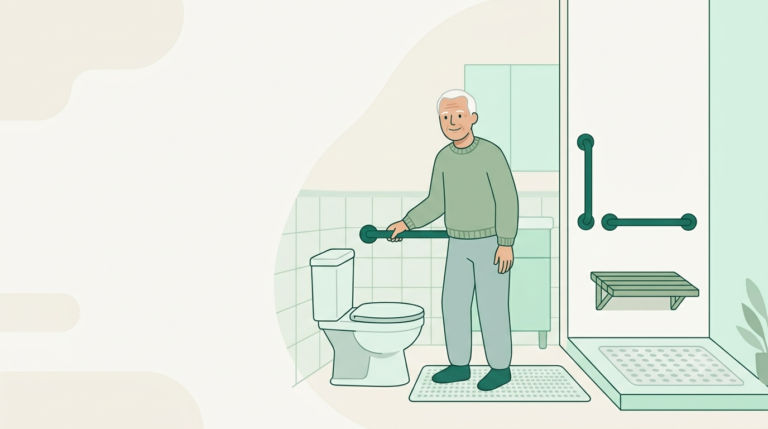
NOTE: Exercise works best alongside other changes, such as making the bathroom safer.
A few principles to apply throughout:
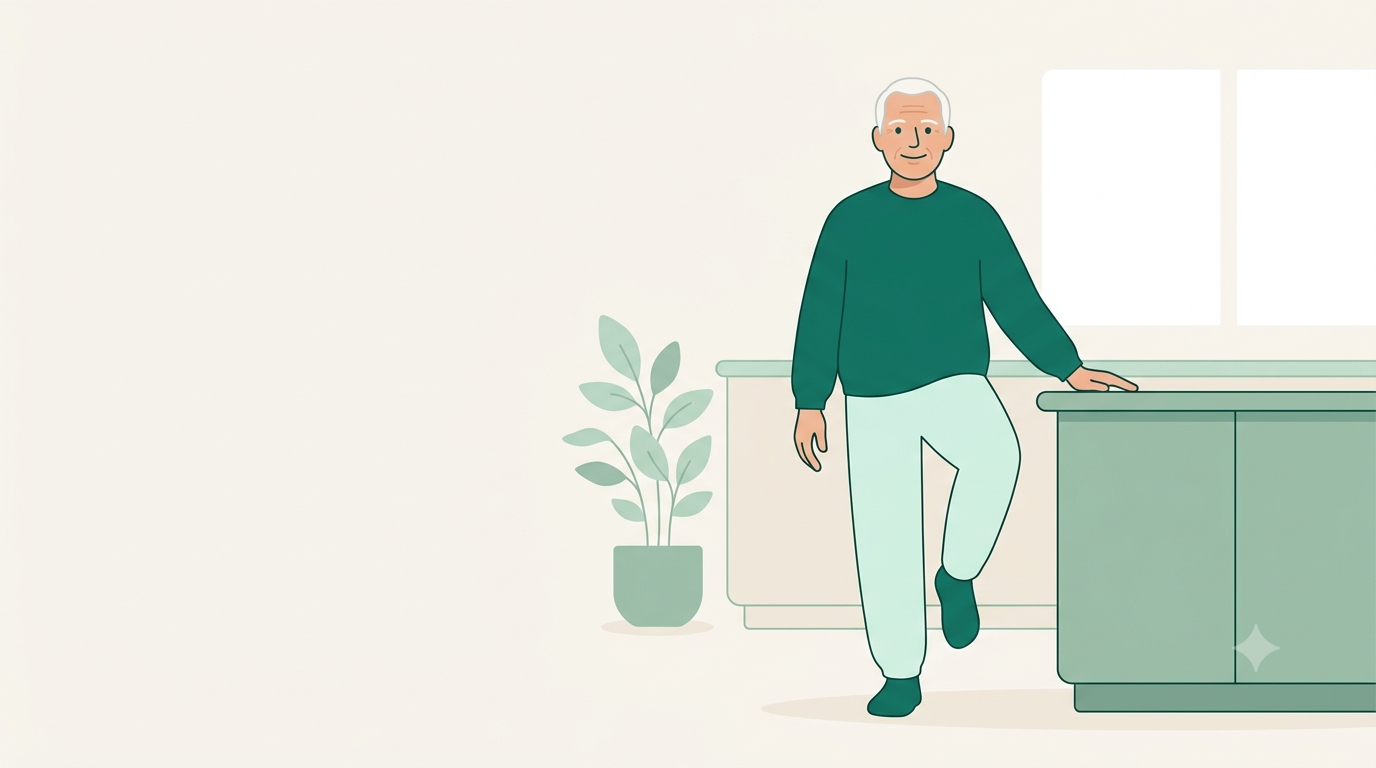
- Prioritise balance. It is the most effective ingredient. Simple moves — standing on one leg while holding a counter, heel-to-toe walking, slow side-to-side weight shifts — are enough to start.
- Build leg strength. Sit-to-stand repetitions from a sturdy chair are the single most useful strengthening exercise for most older adults.
- Keep it gently challenging. The exercises should feel like they test balance a little. If they feel completely effortless, they are unlikely to help. If they feel unsafe, they need supervision.
- Keep going. The benefit comes from ongoing exercise. When people stop, the protective effect fades. This is a long-term habit, not a short course.
What the evidence does NOT support
A few important limits worth knowing:
- Walking alone is not enough. Walking is healthy, but on its own it does not challenge balance the way fall-prevention programmes need to. The evidence singles out balance training specifically.
- Gadgets do not prevent falls. Devices and monitors can help detect or respond to a fall — which matters enormously if someone lives alone — but they do not prevent one the way exercise does. Think of them as a safety net, not a substitute for balance training.
- In nursing homes and care facilities, the picture is more mixed. While exercise strongly prevents falls in people living independently at home, its effect in residential care settings is less clear, and tailored, multi-part programmes tend to work better there. If your parent is in care, balance work still helps, but it should be part of a broader plan.
When to get professional help
Exercise is powerful, but it works best as part of a wider assessment — especially if your parent has already fallen, feels dizzy, or has a medical condition that affects balance.
Consider speaking with:
- Their doctor, who can review medications that may increase fall risk and check for underlying causes of unsteadiness.
- A physiotherapist or occupational therapist, who can prescribe a balance programme matched to your parent’s ability and safety needs. This is the single most valuable step for someone at higher risk.
If your parent has fallen more than once, or fallen and could not get up, treat it as a signal to seek a professional fall-risk assessment promptly.
Key takeaways
- The strongest medical evidence shows that exercise reduces the rate of falls in older adults by about 23% — and this finding is rated high-certainty.
- Balance training is the key ingredient. Programmes that challenge balance and run for at least 3 hours a week work best; walking alone does not.
- Exercise also lowers the risk of fall-related fractures by roughly a quarter — but it reduces risk rather than eliminating it, and the benefit fades if you stop.
Sources
- Sherrington C, Fairhall N, Wallbank G, et al. Exercise for preventing falls in older people living in the community. Cochrane Database of Systematic Reviews, 2019. https://pubmed.ncbi.nlm.nih.gov/31792067/
- Sherrington C, et al. Exercise to prevent falls in older adults: an updated systematic review and meta-analysis. British Journal of Sports Medicine, 2017.
- Effectiveness of exercise intervention on fall-related fractures in older adults: a systematic review and meta-analysis of randomized controlled trials. 2020. https://www.ncbi.nlm.nih.gov/pmc/articles/PMC7650290/
- Centers for Disease Control and Prevention. Older Adult Falls Data. CDC, 2026. https://www.cdc.gov/falls/data-research/index.html
Medical disclaimer: This article is for general information and education. It is not medical advice and does not replace guidance from a qualified healthcare professional. Simon Peter Lokomo holds a Master of Public Health (MPH) and is not a licensed physician. Always consult your parent’s doctor or a qualified therapist before starting a new exercise programme.
Affiliate disclosure: Some links in this article may be affiliate links, meaning we earn a small commission if you make a purchase — at no extra cost to you. We only recommend products consistent with the evidence. Commissions never influence our recommendations.