How to Make a Bathroom Safe for the Elderly: An Evidence-Based Guide
Last reviewed: June 2026
To make a bathroom safe for an elderly parent, focus on three changes the research supports: add sturdy, wall-anchored grab bars by the toilet, tub, and shower; cut slip risk with a non-slip mat and a shower seat; and clear away trip hazards like loose rugs and clutter. These work best as part of a wider home safety check, ideally one done with an occupational therapist.
Why this matters
If you’re reading this after a scare, a slip getting out of the tub, or a parent found sitting on the bathroom floor, you’re not overreacting. The bathroom is one of the most dangerous rooms in the house for an older adult. Wet, hard surfaces, tight spaces, and the simple act of standing up from a low toilet all add up.
The numbers back up that worry. Each year in the United States, older adults make about 3 million emergency department visits and have around 1 million hospital stays because of falls. And a fall in the bathroom tends to be worse than one elsewhere: in one study of older adults, bathroom falls were more than twice as likely to cause an injury as falls in the living room. The good news is that a bathroom is also one of the easiest rooms to make safer, often in an afternoon.
What the evidence says
The strongest evidence here doesn’t come from one product. It comes from looking at the home as a whole. In 2023, Cochrane the group that produces the most respected medical evidence reviews in the world — pulled together 22 studies covering 8,463 older adults to ask a simple question: does fixing hazards around the home actually prevent falls?
Reducing fall hazards around the home lowered the overall rate of falls by about 26% and by roughly 38% for people already at higher risk (for example, someone who has fallen before). Because this comes from a large Cochrane review, researchers are reasonably confident in it. In plain terms, for every 100 falls a higher-risk group might have had, sensible home changes prevented close to 40 of them.
That’s a meaningful drop from changes most families can make. It’s worth knowing which changes carry the most weight, and how solid the evidence is for each — so you can spend your effort where it counts.
| Change | What it does | Evidence strength |
|---|---|---|
| A full home-hazard check (often with an OT) plus the fixes it recommends | Finds and removes the specific risks in this bathroom | Strongest — backed by the Cochrane review above |
| Removing trip hazards (loose rugs, clutter, cords) | Cuts the everyday slips and trips that start many falls | Strong — a core part of what the review tested |
| Grab bars by toilet, tub, and shower | Gives a firm handhold for sitting, standing, and stepping | Recommended by CDC and clinicians; strongest as part of a wider plan (see caveat below) |
| Non-slip mats and a shower seat | Reduces slipping on wet surfaces and the strain of standing to wash | Sensible and low-risk; less tested on its own |
| Better lighting / a night light on the route to the bathroom | Helps avoid missteps on night trips | Widely advised; modest direct evidence |
What to actually do
Here is a practical, room-tested order to work through. You don’t need to do everything at once — start at the top.
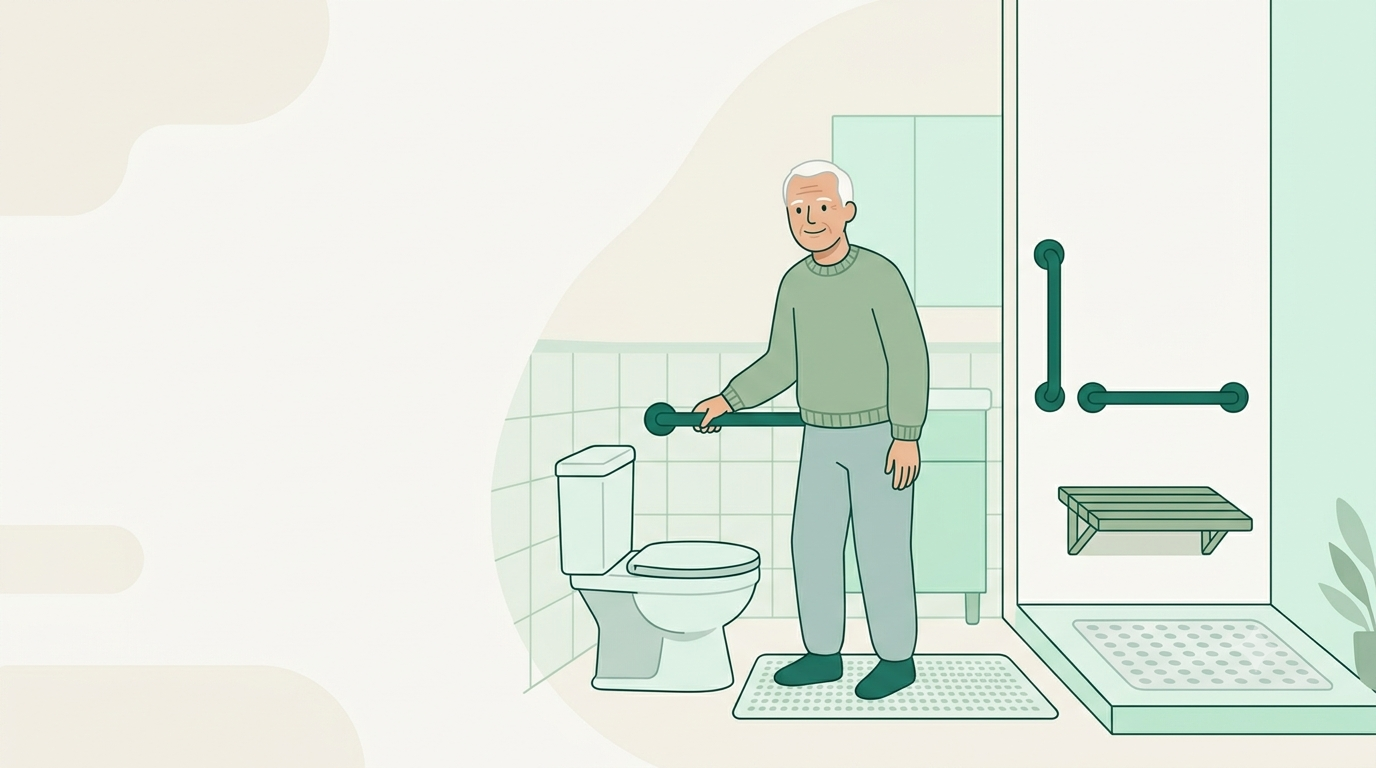
- Install grab bars where the body works hardest. The three high-value spots are beside the toilet, at the tub or shower entrance, and on the wall inside the shower. Choose bars rated to hold at least 250 pounds and mount them at about 33–36 inches from the floor. Anchor them into the wall studs (or use heavy-duty anchors made for the job) screwing into drywall alone is not safe. Skip suction-cup bars for real support; they can let go without warning and are best treated only as a light steadying grip.
- Tackle slippery surfaces. Put a non-slip mat inside the tub or shower and a non-skid rug with a rubber backing outside it. A walk-in shower with a low or no threshold is ideal if a remodel is on the table.
- Add a shower seat or bench. Sitting to wash removes the balance challenge of standing on a wet floor and is far less tiring. Pair it with a handheld showerhead.
- Raise the toilet, if standing is a struggle. A raised toilet seat or a toilet safety frame makes sitting and rising much easier on the knees and lowers the risk of a fall during that transfer.
- Clear the floor and fix the lighting. Remove loose rugs and clutter. Add a bright, easy-to-reach light and a night light along the path from the bedroom to the bathroom.
- Plan for “what if I can’t get up?” For a parent who lives alone, a waterproof medical alert device worn in the shower means help is one button away if a fall does happen. It doesn’t prevent the fall, but it can prevent a long, dangerous wait on the floor.
What the evidence does not support
A single grab bar is not a magic fix. The strong Cochrane evidence is for the whole package — a proper assessment of the home plus the changes it points to — and the benefit was clearest for people already at higher risk of falling. For lower-risk older adults in general, the review found no measurable drop in falls from home changes alone.
It’s also worth being straight about a gap: there is surprisingly little high-quality research testing bathroom equipment by itself. The reviewers specifically noted a shortage of studies on aids for daily tasks like showering. Grab bars are recommended by the CDC and by clinicians, and they make obvious sense, but think of them as one part of a plan, not a guarantee. And no change can “fall-proof” a bathroom. The honest goal is fewer falls, not zero.
When to get professional help
The research is consistent on one point: home changes work best when they’re matched to the actual person and home, rather than picked off a generic checklist. That’s exactly what an occupational therapist (OT) does. An OT can do a home safety assessment, watch how your parent moves through the bathroom, and recommend the specific changes most likely to help. A doctor’s office can refer you, and the visit may be covered.
Reach out to a professional if your parent has already had a fall, feels unsteady or dizzy, takes medicines that cause drowsiness, or is starting to need help with everyday tasks like dressing or bathing — these are signs of higher risk, and the group that benefits most. For the installation itself, a handyman or a Certified Aging-in-Place Specialist (CAPS) contractor can anchor grab bars correctly and handle larger jobs like a walk-in shower. And always talk to your parent’s doctor before assuming dizziness or weakness is “just aging” it may be treatable.
Key takeaways
- Fixing home fall hazards cut the rate of falls by about 26% overall and ~38% for higher-risk older adults in a large Cochrane review.
- Start with stud-anchored grab bars (toilet, tub, shower), then non-slip surfaces, a shower seat, clutter removal, and good lighting.
- The biggest wins come from a tailored plan, ideally guided by an occupational therapist, not from any single gadget.
Sources
- Clemson L, Stark S, Pighills A, et al. Environmental interventions for preventing falls in older people living in the community. Cochrane Database of Systematic Reviews 2023;3:CD013258. cochranelibrary.com
- Centers for Disease Control and Prevention. Facts About Falls (older adult fall prevention), updated 2026. cdc.gov
- CDC STEADI. Older Adult Falls — clinician resources. cdc.gov/steadi
- CDC SAFE Study analysis: circumstances and outcomes of falls among high-risk community-dwelling older adults. stacks.cdc.gov
Medical disclaimer: This article is for general education and is written by a public health professional, not a physician. It is not medical advice and is not a substitute for care from your parent’s doctor, an occupational therapist, or another qualified professional. Always seek personalized guidance for your parent’s situation.
How this site is funded: I do not currently earn a commission on anything mentioned here. If that changes I will say so on every page it applies to, and it will not change an assessment. Several articles on this site advise readers not to buy popular products, and that stays true whatever the funding.