Nighttime Bathroom Falls in Older Adults: Causes and How to Prevent Them
By Simon Peter Lokomo, MPH — Public Health
Last reviewed: July 2026
Nighttime Bathroom Falls in Older Adults
The walk to the bathroom at 3 am stacks several risks on top of each other at once. The person is half asleep, the room is dark, blood pressure drops sharply on standing after hours lying down, and they are often hurrying. Getting up two or more times a night is linked to a meaningfully higher risk of falling. The good news is that this particular trip is one of the easiest fall risks to engineer away, and most of the fixes cost very little.
Almost every home safety guide mentions this in passing. Very few take it apart properly, which is a shame, because understanding why the trip is dangerous tells you exactly which changes are worth making and which are window dressing.
Why is the nighttime bathroom trip so risky?
Because four separate problems arrive at the same moment. Individually each is manageable. Together they produce the conditions for a fall.
Grogginess. Someone woken from deep sleep has slower reaction times and poorer judgement for several minutes. Balance recovery depends on reacting quickly to a stumble, and that reaction is blunted.
Darkness. Older eyes adapt to changing light more slowly and need considerably more light to see clearly. A room that looks dim to you may be close to unnavigable for a person in their eighties. Glasses matter here too, since the ability to pick out an edge against its background falls away in low light, and that effect compounds if someone wears varifocals, as we cover in do bifocals increase fall risk.
Blood pressure. Standing up after hours lying flat is the moment of greatest circulatory stress in the whole day. Blood pools in the legs, pressure to the brain drops briefly, and the result is that lightheaded few seconds most people recognize. In older adults that drop can be larger and last longer.
Urgency. People do not stroll to the bathroom at night. They hurry, often without their glasses, often without the walking aid they would use in daylight.
Add a bed that is slightly too high, a bath mat with a curled edge, and slippers with no grip, and the trip becomes genuinely hazardous.
How common is getting up at night?
Very. Waking at least once in the night to pass urine is called nocturia, and it becomes close to universal with age. By 80, around 80 percent of people get up at least once. It is so common that most people, and a fair number of clinicians, treat it as an unavoidable part of aging and never discuss it. Women in particular are often reluctant to raise it.
That silence matters, because nocturia frequently has a treatable cause. It can stem from bladder problems, an enlarged prostate, heart or kidney conditions, poorly controlled diabetes, sleep apnoea, or from medication, particularly diuretics. Fluid that has collected in the legs during the day also returns to the circulation once someone lies down, which produces urine overnight. None of that is simply age.
Does getting up at night really increase fall risk?
The association is consistent, though the evidence has real limits worth understanding. A systematic review and meta-analysis found that nocturia was associated with roughly a 20 percent higher relative risk of falls. Translated into absolute terms, which is more useful, the risk of falling at least once in a year was about 5.5 percentage points higher for a 65 year old with nocturia compared with someone without, and about 7.5 points higher at age 80.
Several studies point the same way. Getting up two or more times a night has been linked to increased hip fracture risk, and one community study that deliberately excluded people who had already fallen found that three or more trips a night was associated with a 28 percent higher risk of a first fall over the following three years. Excluding prior fallers matters, because previous falls are such a strong predictor that they can otherwise swamp the analysis.
The pattern extends beyond falls. A separate meta-analysis found nocturia associated with roughly a 1.3 times higher risk of death, rating the evidence moderate quality for nocturia as a prognostic marker but very low for it being a cause. That is the same shape as the falls evidence: a consistent signal that something is wrong, without proof that the night trips themselves are doing the damage.
Now the honest limitation. These are observational findings, and the reviewers who assembled them rated the evidence low quality for prediction and very low for causation. More importantly, no clinical trial has yet tested whether treating nocturia actually reduces falls. So the sensible reading is that frequent night trips mark someone as higher risk and give you a specific, addressable situation to make safer. It is not proof that reducing the trips will by itself prevent a fall.
Frequent nighttime toileting is consistently associated with falls, and the trip itself combines darkness, drowsiness and a blood pressure drop in one short journey. Treat it as a specific route to make safe rather than a vague worry. The practical measures below are cheap, carry no downside, and address a moment we know is risky.
Why do people feel dizzy standing up at night?
It is called orthostatic hypotension, and it means blood pressure falls when you change position. Clinically it is defined as a sustained drop of at least 20 mmHg systolic or 10 mmHg diastolic on moving from lying to sitting or standing. It is common in older adults, with prevalence reported as high as 60 percent in care and hospital settings, and rising from bed after a night lying flat is when it hits hardest.
Worth being straight about the evidence here too. The link between orthostatic hypotension and falls is less clean than it is often presented. One systematic review found the relationship inconsistent, and a large hospital study that found the condition in nearly half of its patients concluded it had not led to falls in that group. So it is a plausible contributor rather than a proven cause.
What is not in dispute is the clinical advice. Guidance on managing orthostatic hypotension explicitly warns patients about the increased risk of low blood pressure and falls when standing at night to urinate, and recommends using a urinal or bedside commode to avoid the trip altogether. When specialists managing this condition give that advice, it is worth following.
Several common medications can worsen it, including blood pressure drugs, some antidepressants and antipsychotics, and Parkinson’s medications. This overlaps with the drugs that raise fall risk generally, which we covered in medications that increase fall risk. It is a good thing to ask a pharmacist about.
What actually makes the trip safer?
Work through it as a route, from the bed to the toilet and back. Each stage has a fix.
| Stage of the trip | What to change |
|---|---|
| Waking | A lamp or flashlight within arm’s reach, so nobody navigates in the dark to find a switch |
| Sitting up | Sit on the edge of the bed for a slow count of thirty before standing, and let any dizziness pass |
| Standing | Bed at a height where feet rest flat on the floor. Walking aid parked within reach, and actually used |
| The route | Motion-activated night lights along the whole path. Nothing on the floor. No loose rugs or trailing cords |
| Footwear | Nonslip slippers kept beside the bed. Bare feet slip on hard floors and plain socks are worse |
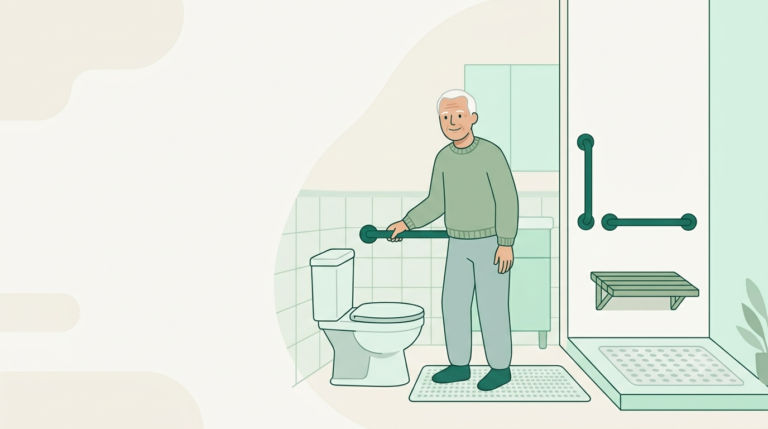
| The bathroom | A soft light left on, a properly mounted grab bar by the toilet, nonslip flooring |
| The trip itself | A bedside commode or urinal removes the journey entirely for those at highest risk |
Two of these do most of the work, and the lighting one now has better evidence behind it than it used to.
Light the whole route, not just the bedroom. A randomized crossover trial in assisted living residents with dementia tested low intensity LED strips that outlined the bathroom doorframe, giving a visual cue for postural stability. Compared with a standard nightlight in the bedroom and bathroom, the doorframe system was associated with a 34 percent decrease in falls, and a larger trial following 335 residents for a year is now underway. Separately, a study of 126 residents across 12 long term care facilities found that higher bathroom lighting predicted lower fall rates, with each 100 lux increase associated with roughly 13 percent fewer falls. That study also found most rooms were underlit, with over two thirds of bathrooms below recommended levels.
Two honest caveats. Both of those studies were done in care settings rather than private homes, so nobody has run the equivalent trial in a family house. And the trial compared a doorframe lighting system against a standard nightlight, which means it shows path lighting beating a single dim lamp rather than showing that any nightlight beats darkness. The practical reading is that a single nightlight in the hallway is probably not enough, and lighting the actual route, including the bathroom doorway, is what appears to help. Motion activated lights do this without anyone having to find a switch while unsteady.
A bedside commode deserves more consideration than it usually gets. People resist it, understandably, because it feels like a loss of dignity. But it eliminates the risky journey completely, and for someone with real balance problems or marked dizziness on standing it is the single most effective option available. It need not be permanent. Many families use one during a recovery period and put it away afterwards.
For the bathroom end of the route, our guide to bathroom safety modifications that actually work covers grab bar placement and flooring, and the home safety checklist covers clearing the path.
It is also worth planning for the fall that happens anyway, because a nighttime fall carries a particular risk. Someone who falls at 3am and cannot get up may lie there until morning, and time on the floor causes its own harm. Knowing the technique for getting up, and having a way to call for help, both matter more at night than at any other time. We cover both in how to get up after a fall and do medical alert systems actually save lives.
Families often respond to nighttime getting up by buying a bed rail, on the reasoning that it will keep the person safely in bed. It does not work that way. Rails have not been shown to prevent falls, they carry a documented risk of fatal entrapment, and someone determined to reach the bathroom will climb over one and fall from a greater height. We set out the evidence in are bed rails safe for an elderly parent. Make the trip safer instead of trying to prevent it.
Should they drink less in the evening?
Ask the doctor before making this change, because it is easier to get wrong than it looks. Cutting fluids in the evening is the standard advice people find online, and for some it genuinely helps. But older adults are already prone to dehydration, and drinking too little brings its own problems, including urinary infections, constipation, confusion and, awkwardly, dizziness on standing, which is the very thing you are trying to avoid.
The safer approach is to shift the timing rather than cut the total, and to have someone look at the actual cause. If a diuretic is contributing, the timing of that dose is a decision for the prescriber and not something to adjust independently. If fluid is pooling in the legs during the day, raising the legs in the late afternoon may reduce what returns overnight. If sleep apnoea or a prostate problem is behind it, treating that is the real answer.
This is why raising nocturia with a doctor is worth doing, even though it feels like a minor complaint. It is treatable more often than people assume.
What the evidence does NOT support
- That reducing night trips has been proven to prevent falls. The association is consistent, but no trial has tested a nocturia treatment with falls as the outcome.
- That orthostatic hypotension reliably causes falls. Reviews find the relationship inconsistent, and one large study found no link. It remains a plausible contributor and worth managing.
- That a bed rail solves nighttime getting up. It does not prevent falls and introduces an entrapment risk.
- That nocturia is just aging. It is common with age, but frequently has a treatable cause worth investigating.
- That drinking less is automatically the answer. Dehydration in older adults carries real risks, including worse dizziness on standing.
When to get help
Mention nighttime trips at the next appointment, and be specific about how many times a night, since frequency is what the research tracks. Ask whether any current medication could be contributing, and whether the underlying cause has been identified. Nocturia is treatable often enough that it should not be accepted without a look.
Ask about blood pressure on standing as well. Measuring it lying down and then standing takes a few minutes and identifies orthostatic hypotension, which changes what is worth doing and sometimes prompts a medication review.
If nighttime waking comes with confusion or agitation rather than simply needing the toilet, that is a different situation, and our guide to sundowning and difficult evenings is the better starting point. And if falls are already happening, what to do when a parent keeps falling covers the full assessment.
One further thing worth watching. If someone has started avoiding drinking in the evening, or has become anxious about getting up in the dark, that avoidance can quietly shrink their world and weaken them over time. That pattern has a name and a treatment, covered in fear of falling in older adults.
Key takeaways
- The nighttime bathroom trip combines drowsiness, darkness, a blood pressure drop on standing, and hurrying, all within a minute or two.
- By age 80, around 80 percent of people get up at least once a night, and doing so two or more times is associated with higher fall risk.
- The association is consistent but observational, and no trial has shown that treating nocturia prevents falls.
- Best value changes: light the whole route rather than one corner, sit on the edge of the bed before standing, wear nonslip slippers, and keep the path clear. Trial evidence favors path and doorway lighting over a single dim nightlight.
- A bedside commode removes the trip entirely for those at highest risk. A bed rail is not a solution and carries its own dangers.
Frequently asked questions
Why do elderly people fall at night going to the bathroom?
Several risks combine in one short trip. The person is drowsy and slower to react, the room is dark and older eyes adapt poorly to low light, blood pressure drops on standing after hours lying flat, and they are usually hurrying, often without glasses or a walking aid. Add a high bed, loose rugs or slippery footwear and the trip becomes genuinely hazardous.
Does getting up at night to urinate increase fall risk?
It is consistently associated with higher risk. A meta-analysis found nocturia linked to roughly a 20 percent higher relative risk of falls, and one community study that excluded people who had already fallen found three or more trips a night associated with a 28 percent higher risk of a first fall within three years. The evidence is observational, and no trial has yet shown that reducing night trips prevents falls.
What is nocturia and is it a normal part of aging?
Nocturia means waking at least once in the night to pass urine, with sleep before and after. It becomes very common with age, affecting around 80 percent of people by 80, but common is not the same as untreatable. It can be caused by bladder or prostate problems, heart or kidney conditions, diabetes, sleep apnoea, or medications such as diuretics, and many of these can be addressed.
How can I make nighttime bathroom trips safer for my parent?
Light the entire route with motion-activated night lights, keep a lamp within arm’s reach of the bed, and clear the path of rugs and cords. Encourage sitting on the edge of the bed for around thirty seconds before standing, to let any dizziness pass. Keep nonslip slippers and any walking aid beside the bed. For someone at high risk, a bedside commode removes the journey completely.
Should an older person stop drinking fluids in the evening?
Not without medical advice. Reducing evening fluids helps some people, but older adults are prone to dehydration, and drinking too little can cause urinary infections, constipation, confusion and worse dizziness on standing. Shifting the timing of fluids rather than cutting the total is usually safer, and any change to diuretic timing is a decision for the prescriber.
Do night lights actually prevent falls?
The evidence is better for lighting the route than for a single lamp. A randomized crossover trial in assisted living found that low intensity LED strips outlining the bathroom doorframe were associated with 34 percent fewer falls compared with a standard nightlight, and a separate study across 12 care facilities found higher bathroom lighting predicted lower fall rates. Both were carried out in care settings rather than private homes, so treat this as promising rather than proven, and light the whole path rather than one corner of it.
Are bed rails a good way to stop nighttime falls?
No. Bed rails have not been shown to prevent falls, and regulators have recorded hundreds of entrapment deaths involving portable bed rails. Someone determined to reach the bathroom is likely to climb over the rail and fall from a greater height. Making the trip safer with lighting, a clear route and, where needed, a bedside commode is both safer and more effective.
HomeAgingGuide.com provides evidence-based information, not medical advice. Simon Peter Lokomo holds an MPH in public health and is not a licensed physician. Do not change fluid intake, medication timing, or any prescribed treatment without speaking to a qualified clinician. Frequent nighttime waking to urinate is worth raising with a doctor, as it often has a treatable cause.