Balance Exercises for Seniors to Prevent Falls
Reviewed by Simon Peter Lokomo, MPH
Last reviewed: June 2026 · Evidence tier: Cochrane · Sources: Cochrane Library, CDC STEADI
Balance exercises are one of the most effective ways to help an older adult avoid falls, but with an important detail most people miss. The strongest evidence shows that challenging a person’s balance is the key ingredient in fall prevention, yet balance moves work best as part of a structured routine that also builds leg strength, rather than done in isolation. Simple, proven options include standing on one leg, heel-to-toe walking, and tai chi. Aim for at least three hours a week, kept up over time.
Why this matters
Balance naturally declines with age. The systems that keep us steady, the inner ear, vision, muscle strength, and the reflexes that catch us when we stumble, all weaken gradually. Most people do not notice until a near-miss on the stairs or an unsteady moment getting out of a chair.
The good news is that balance is trainable at any age. Unlike many parts of aging, this one responds directly to practice. About one in four adults over 65 falls each year, and falls are the leading cause of injury in this age group, yet the research shows that the right kind of exercise can cut the rate of falls substantially. Balance training is at the heart of that.
What the evidence says
This is where the detail matters, because the evidence is more nuanced than the typical “do these five moves” article suggests.
The key finding
The landmark 2019 Cochrane review which combined 59 trials and nearly 13,000 older adults, and is rated high-certainty evidence found that exercise reduces the rate of falls by about 23%. Crucially, the programmes that worked best were those that strongly challenged balance and were done for at least three hours a week. Balance is the active ingredient.
But here is the nuance. More recent research comparing different exercise types head-to-head found that the most effective programmes are not balance drills done alone they are structured, multi-part programmes that combine balance training with leg strengthening. Two well-studied examples, the Otago Exercise Programme and the Falls Management Exercise (FaME) programme, consistently come out on top. Both are built around balance, but they pair it with strength work and progress over time.
Tai chi also performs well in the research one network analysis found the simplified 24-form style reduced the incidence of falls meaningfully compared to no exercise. Its slow, continuous weight shifts are essentially balance training in disguise.
The practical takeaway: do not just collect a few balance moves. Use balance as the core, but combine it with leg strengthening and keep progressing the difficulty. That is what the strongest evidence supports.
The best balance exercises to start with
These are simple, evidence-aligned exercises that challenge balance safely. The golden rule: always have something sturdy within reach to hold a kitchen counter, a heavy chair, or a wall, especially at first.
| Exercise | How to do it | What it trains |
|---|---|---|
| Single-leg stand | Hold a counter, lift one foot a few inches, hold 10–30 seconds, switch | Static balance |
| Heel-to-toe walk | Walk a straight line placing the heel directly in front of the opposite toe | Dynamic balance & coordination |
| Sit-to-stand | Rise from a sturdy chair without using hands, sit back slowly, repeat | Leg strength (the partner to balance) |
| Side leg raises | Hold a chair, lift one leg out to the side, lower slowly, switch | Hip strength & lateral stability |
| Weight shifts | Stand feet hip-width, slowly shift weight side to side, then front to back | Balance control |
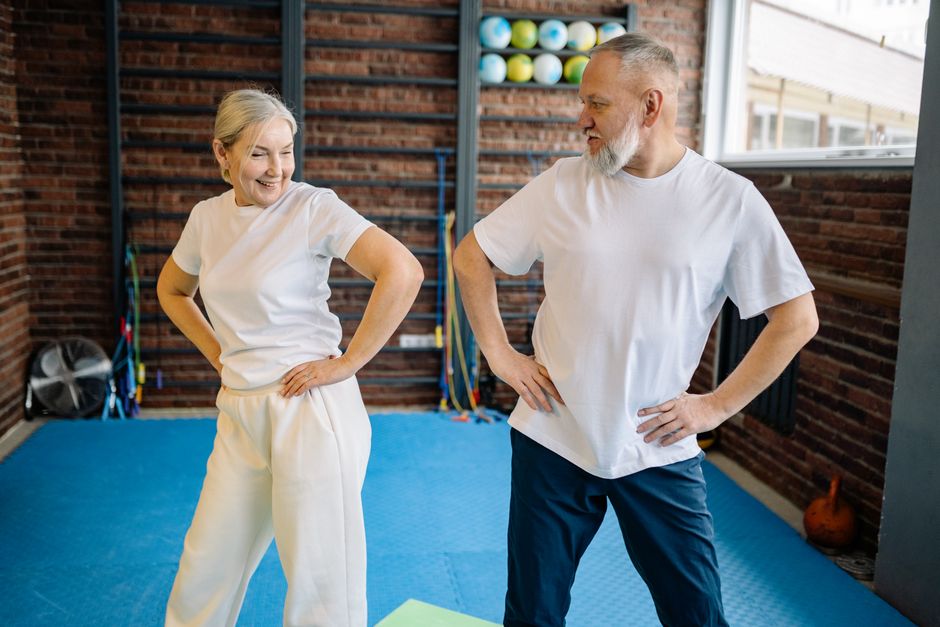
| Tai chi | Follow a class or video of the 24-form simplified style | Balance, strength & coordination together |
What to actually do
- Build a routine, not a one-off. Aim for around three hours a week total — this is the threshold where the research shows the strongest benefit. It can be split into short daily sessions.
- Combine balance with strength. Pair the balance moves above with sit-to-stands and side leg raises. The most effective programmes always include both.
- Make it gradually harder. As balance improves, hold the support more lightly, then with one finger, then briefly not at all (only when safe). Progression is what keeps the benefit coming.
- Consider a proven programme. The Otago and FaME programmes are well-researched and often delivered through physiotherapists or community classes. Tai chi classes for seniors are widely available and genuinely effective.
- Keep going. The protective effect fades when exercise stops. This is a permanent habit, like brushing teeth not a six-week course.
What the evidence does not support
An honest caveat
A few honest limits. First, walking alone is not balance training. Walking is good for general health, but on its own, it does not challenge balance enough to prevent falls. The evidence is specific about that. Second, a couple of balance moves done occasionally will do little; the benefit comes from a real, ongoing, progressive routine. Third, no amount of exercise makes anyone fall-proof; it reduces risk, but it does not eliminate it.
And a safety point: balance exercises by definition push the edge of stability. For someone who is frail, very unsteady, or recovering from a fall, starting unsupervised can itself be risky. Those individuals should begin with professional guidance, not a video alone.
When to get professional help
A physiotherapist is the ideal professional to design a balance programme matched to your parent’s current ability especially if they have already fallen, feel unsteady, or have a condition affecting balance. A doctor can refer you, and an assessment ensures the exercises are challenging enough to help but safe enough to do.
If your parent has fallen more than once, treat balance exercise as one part of a broader fall-risk assessment that also reviews medications, vision, and home hazards. Exercise is powerful, but it works best within that fuller picture.
Frequently asked questions
How long before balance exercises make a difference?
Many people notice improved steadiness within a few weeks of consistent practice, but the fall-prevention benefit depends on continuing long-term. Studies showing reduced falls typically involved programmes lasting several months or more.
Is tai chi really as good as it sounds?
The evidence for tai chi is genuinely strong. Its slow, controlled weight shifts train balance, strength, and coordination at once, and it has the practical advantage of needing no equipment. For many older adults it is one of the most enjoyable and sustainable options.
What if my parent is afraid of falling during the exercises?
That fear is common and valid. Start with a sturdy support to hold, keep sessions short, and consider beginning with a physiotherapist or a supervised class. Building confidence safely is part of the goal — fear of falling can itself increase fall risk by making people move stiffly and avoid activity.
Key takeaways
- Challenging balance is the core ingredient in fall prevention — high-certainty evidence shows the right exercise cuts the rate of falls by about 23%.
- Balance works best combined with leg strengthening in a structured, progressive routine (like Otago, FaME, or tai chi) — not as a few moves done in isolation.
- Aim for about three hours a week, keep progressing the difficulty, and keep it up long-term — the benefit fades when you stop.
Sources
- Sherrington C, Fairhall N, Wallbank G, et al. Exercise for preventing falls in older people living in the community. Cochrane Database of Systematic Reviews, 2019. pubmed.ncbi.nlm.nih.gov
- Optimal type and dose of exercise to improve fall behavior in older adults: a systematic evaluation and network meta-analysis. 2025. sciencedirect.com
- The effects of different types of Tai Chi exercises on preventing falls in older adults: a systematic review and network meta-analysis. 2024. pmc.ncbi.nlm.nih.gov
- Centers for Disease Control and Prevention. Older Adult Falls Data. 2026. cdc.gov
Medical disclaimer: This article is for general education and is written by a public health professional, not a physician or physiotherapist. It is not medical advice. Check with a doctor before starting a new exercise programme, especially after a fall or with a medical condition. Always seek personalized guidance for your parent’s situation.
How this site is funded: I do not currently earn a commission on anything mentioned here. If that changes I will say so on every page it applies to, and it will not change an assessment. Several articles on this site advise readers not to buy popular products, and that stays true whatever the funding.