Do grab bars prevent falls?
Reviewed by Simon Peter Lokomo, MPH
Last reviewed: June 2026 · Evidence tier: RCT · Sources: PubMed, CDC STEADI
Do grab bars prevent falls? The honest answer is: they clearly help, but with an important nuance. Strong biomechanical research shows grab bars make getting in and out of the bath or shower measurably safer and help people recover their balance when they slip. What is surprisingly thin is high-quality proof that a grab bar on its own reduces the overall number of falls. The takeaway: grab bars are a worthwhile, low-cost safety measure — especially in the bathroom — but they work best as one part of a wider fall-prevention plan, not a standalone fix.
Why this matters
Grab bars are usually the first thing families install when they worry about a parent falling. They are inexpensive, easy to fit, and feel reassuring. That instinct is sound — but it helps to know exactly what the evidence says they do and do not do, so you can spend your effort where it counts.
The bathroom is the right place to focus. It is one of the most dangerous rooms in the home for older adults: wet, hard surfaces combined with the awkward movements of stepping into a tub or rising from a low toilet. About one in four adults over 65 falls each year, and a serious share of those falls happen during exactly these bathroom transfers. So the question is not really “are grab bars good?” but “what kind of protection do they actually give — and where do they fall short?”
What the evidence says
Here is where it pays to look closely, because the picture is more nuanced than most websites admit.
The key finding
A 2023 study in the journal Human Factors tested older adults stepping out of a slippery bathtub during an unexpected loss of balance. Those using a grab bar were far better able to recover and avoid a hazardous fall — the research found participants were 75.8% more likely to recover their balance during a bathtub exit when a grab bar was available. The mechanism is clear: a firm handhold gives the body something to catch itself on at the exact moment balance is lost.
That is strong, direct evidence for what grab bars do in the moment. But there is an honest gap worth understanding. A 2026 systematic review of home modifications noted that while grab bars are widely recommended, studies often did not isolate the grab bar from other changes, and few measured the effect of a grab bar alone on the total number of falls. In other words: we have good biomechanical proof that grab bars help you catch yourself, but weaker proof that simply installing one reduces how often you fall overall.
This is not a reason to skip them — it is a reason to understand their role. Grab bars are a tool for safer transfers and balance recovery. Reducing your overall fall risk takes more than one bar on a wall.
Placement matters more than most people realise
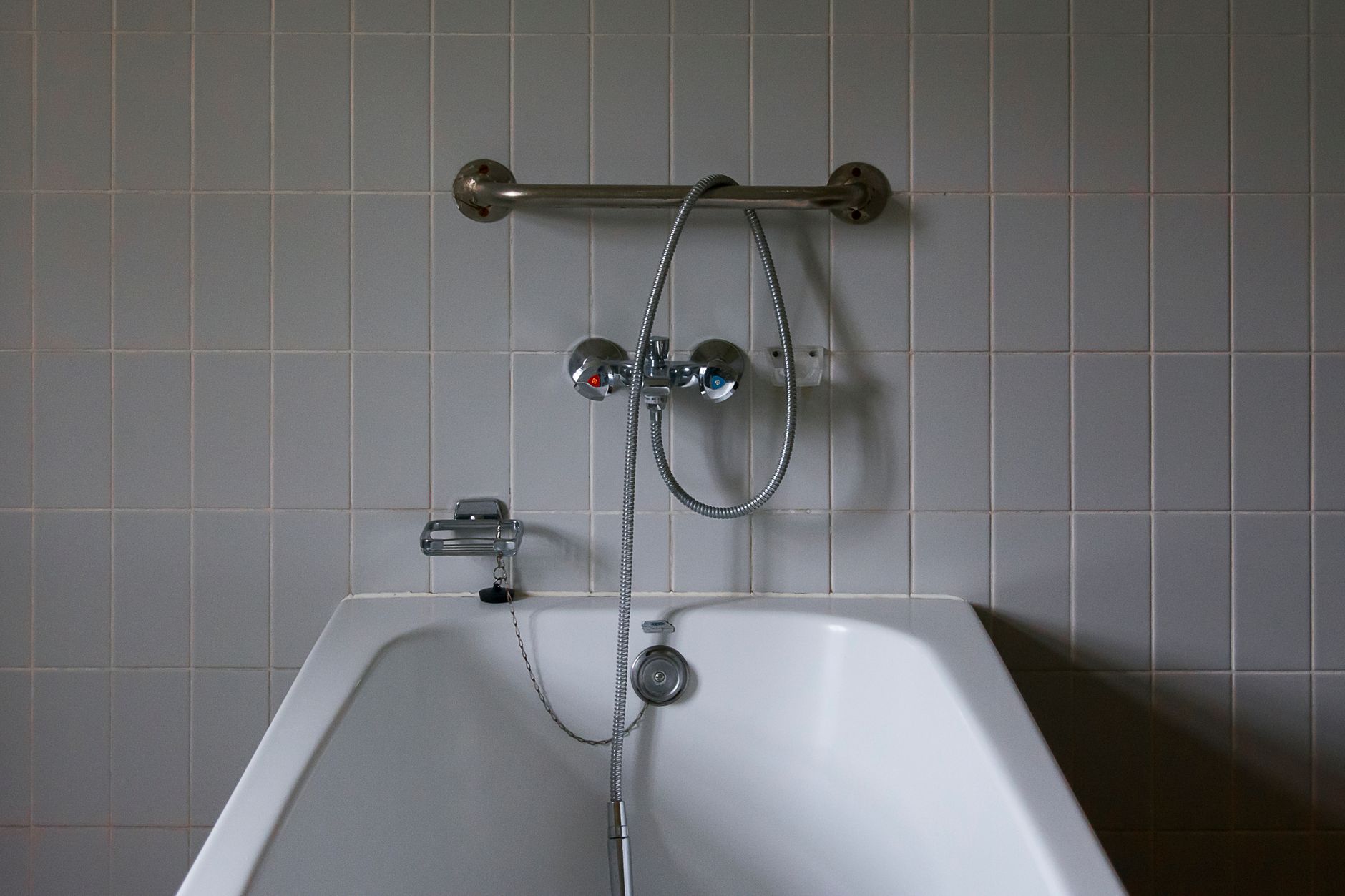
The research is clear that how and where a grab bar is mounted strongly affects how well it works. A separate biomechanics study from the same research group tested older adults stepping in and out of a slippery bathtub using different aids, and found that a vertical grab bar on the side wall produced the safest, best-controlled transfers — better than a horizontal bar on the back wall, a bath mat, or no aid at all. Position is not a detail; it is central to whether the bar actually helps.
| Location | What it helps with | Best orientation |
|---|---|---|
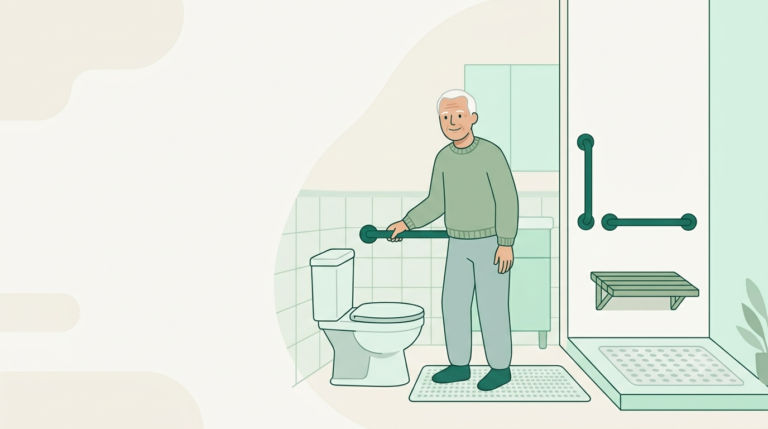
| Beside the toilet | Sitting down and standing up from a low seat | Horizontal or angled, on the wall nearest the toilet |
| At the tub/shower entrance | The high-risk step in and out | Vertical — best evidence for safe transfers |
| Inside the shower | Steadying while washing on a wet surface | Horizontal or angled within easy reach |
| Near the sink | Balance while leaning over the basin | Horizontal, if space allows |
What to actually do
- Prioritise the tub or shower entrance. This is the highest-risk transfer and where the evidence for grab bars is strongest. A vertical bar here is the single most evidence-backed placement.
- Add a bar beside the toilet. Rising from a low toilet is a common moment for a fall; a well-placed bar makes it markedly easier and safer.
- Anchor into wall studs. A grab bar is only as safe as its mounting. It must be fixed into the wall studs or with heavy-duty anchors rated for the load — screwing into drywall alone is dangerous. Choose bars rated to hold at least 250 pounds.
- Be very cautious with suction-cup bars. These are popular because they need no drilling, but they can release without warning and should never be trusted as primary support. At most, treat them as a light steadying aid — not something to bear your full weight.
- Combine with the rest of a bathroom safety plan. Grab bars work best alongside non-slip mats, a shower seat, good lighting, and clutter removal. The combination is what meaningfully lowers risk.
What the evidence does not support
An honest caveat
Do not treat a grab bar as a complete solution. The evidence supports it as an aid to safe transfers and balance recovery — but there is limited high-quality proof that a grab bar alone reduces a person’s overall rate of falls. A single bar on the wall is not “fall-proofing” a home.
Two specific cautions. First, suction-cup grab bars are not a substitute for properly anchored ones; relying on them for full weight is genuinely risky. Second, a grab bar does nothing for the underlying drivers of falls — muscle weakness, balance decline, medication side effects, poor vision. If a parent is falling, the bar is worth installing, but it should sit alongside balance exercise, a medication review, and a professional home assessment, which is where the strongest fall-prevention evidence lies.
When to get professional help
For placement and installation, an occupational therapist (OT) is the ideal professional. An OT can watch how your parent actually moves through the bathroom and recommend the exact bar positions most likely to help — which the research shows matters enormously. For the installation itself, a handyman or a Certified Aging-in-Place Specialist (CAPS) contractor can ensure bars are anchored safely into studs.
And if your parent is already falling, treat grab bars as one step within a broader medical conversation. Ask their doctor for a fall-risk assessment, which looks at all the contributing factors rather than just the bathroom.
Frequently asked questions
Are suction-cup grab bars safe?
Only as a light steadying aid, never for full weight-bearing support. Suction-cup bars can lose their grip without warning, especially on textured or wet surfaces. For real support, use a bar screwed into the wall studs.
What height should a grab bar be installed at?
A common guideline is roughly 33–36 inches from the floor, but the right height depends on the person and the task. Because placement strongly affects effectiveness, an occupational therapist’s input is genuinely valuable here.
Will Medicare or Medicaid pay for grab bars?
Original Medicare generally does not cover grab bars, but some Medicare Advantage plans now include home-safety benefits, and many state Medicaid waiver programs help fund home modifications. It is worth checking both before paying out of pocket.
Key takeaways
- Grab bars clearly improve safety during bathing transfers — research found people were about 75% more likely to recover their balance during a bathtub exit with one.
- Evidence that a grab bar alone reduces overall falls is limited, so treat it as one part of a wider plan, not a complete fix.
- Placement and secure mounting are critical: a vertical bar at the tub entrance, anchored into studs, is the most evidence-backed choice. Avoid relying on suction-cup bars.
Sources
- Levine IC, Montgomery RE, Novak AC. Grab Bar Use Influences Fall Hazard During Bathtub Exit. Human Factors, 2023;65(8):1821–1829. PubMed: 34963373. journals.sagepub.com
- King EC, Novak AC. Effect of bathroom aids and age on balance control during bathing transfers. American Journal of Occupational Therapy, 2017 (vertical vs. horizontal bar comparison). doi.org
- The influence of home modifications on falls in community-dwelling older adults: A systematic review. Assistive Technology, 2026. tandfonline.com
- Rand M, et al. Efficacy of Installation of Temporary Bathing Transfer Aids by Older Adults. Gerontology & Geriatric Medicine, 2024. ncbi.nlm.nih.gov
- Centers for Disease Control and Prevention. Older Adult Falls Data. 2026. cdc.gov
Medical disclaimer: This article is for general education and is written by a public health professional, not a physician or occupational therapist. It is not medical advice. Always seek personalized guidance for your parent’s situation.
How this site is funded: I do not currently earn a commission on anything mentioned here. If that changes I will say so on every page it applies to, and it will not change an assessment. Several articles on this site advise readers not to buy popular products, and that stays true whatever the funding.